Rice Milling Process: From Paddy to White Rice
Rice milling converts harvested paddy into edible rice by removing the outer husk and part or all of the bran layer. A simple mill may combine several operations in one machine, while a modern commercial milling line separates the process into multiple stages to improve control, reduce grain damage and produce more uniform finished rice.
On this page
The Rice Milling Process at a Glance
Follow the main material stream through the stages below. Unhusked paddy returns to the husker after separation; husk and bran leave through separate outlets.
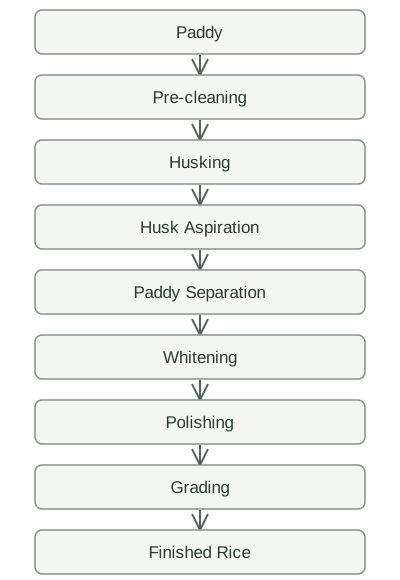
1. Pre-cleaning
Before milling, paddy may contain straw, dust, empty grains, stones and other foreign material.
Pre-cleaning removes large and light impurities before they reach downstream machines.
This matters because impurities can reduce processing efficiency, contaminate the final rice and increase wear on milling equipment.
Output: Cleaner paddy ready for husking.
2. Husking
Husking removes the outer hull from paddy.
In modern mills, a rubber roll husker is commonly used. Paddy passes between two rubber-covered rolls operating with a small clearance and usually at different peripheral speeds.
The mechanical action removes the husk while attempting to minimize damage to the rice kernel.
The output is normally a mixture containing:
- brown rice
- unhusked paddy
- husk
Learn how a rubber roll husker works.
3. Husk Aspiration
After husking, loose husk must be separated from the heavier grain.
Airflow is commonly used to remove the lightweight husk.
Insufficient aspiration may leave husk or unfilled grains mixed with the brown rice, while poorly adjusted airflow can also affect process efficiency.
4. Paddy Separation
Not every grain is necessarily husked during the first pass.
A paddy separator separates unhusked paddy from brown rice.
The unhusked paddy can then return to the husker while brown rice continues toward whitening.
Separating paddy before whitening is important because sending unhusked grains into the whitener can increase unnecessary mechanical stress and equipment wear.
5. Whitening
Brown rice still contains bran layers.
A rice whitener removes part or most of this bran layer.
Two important whitening principles are:
- abrasive whitening
- friction whitening
Commercial systems may use more than one whitening stage instead of trying to remove all bran in one aggressive pass.
This can help control heat generation and mechanical stress.
6. Polishing
Polishing is a finishing operation.
It removes remaining loose bran particles and improves the surface appearance of milled rice.
Whitening and polishing are related but are not exactly the same operation.
7. Grading
Finished milled rice contains grains of different lengths and may contain broken kernels.
Grading equipment separates head rice, larger broken rice and smaller broken fragments according to the required product specification.
Why Rice Breaks During Milling
The milling process applies mechanical forces to rice kernels.
Breakage may increase when:
- paddy is too dry
- grains were already cracked before milling
- whitening pressure is too high
- machine components are worn
- too much processing is attempted in one stage
- machine settings do not match the paddy condition
Too Much Broken Rice: Causes and Solutions
Rice Moisture Matters
Paddy moisture has a major influence on milling behavior.
Very dry kernels are more susceptible to breakage.
As a practical reference, around 14% moisture content is commonly cited for milling, but actual optimum conditions can vary with rice variety, drying history and processing conditions.
Operators should measure moisture rather than relying only on visual judgement.
Simple Mills vs Multi-stage Mills
Simple rice mills combine several operations into a compact machine.
Advantages:
- lower initial cost
- simple installation
- fewer machines
- easier operation in small mills
Limitations:
- less independent control
- greater mechanical stress may occur
- finished rice quality can be more difficult to optimize
Multi-stage systems separate husking, separation, whitening and finishing.
Advantages:
- better process control
- easier adjustment
- potential for better head rice recovery
- more consistent finished product
Limitations:
- higher investment
- more space
- more equipment
- greater maintenance requirement
Next Steps
If you want to understand individual machines:
If you have a milling problem:
Sources & Technical References
References support general principles. Machine-specific settings require the matching manufacturer manual.
- Commercial rice milling systems ↗IRRI Rice Knowledge Bank · Process-stage definitions and line arrangement.
- Paddy quality ↗IRRI Rice Knowledge Bank · Incoming grain quality and its effect on milling.
- RCEF Knowledge Bank: Milling ↗Philippine Center for Postharvest Development and Mechanization (PHilMech) · General milling definitions and mill types; no N90 specification is inferred.
- Agricultural machinery training resources: Practical Manual for Post-harvest Processing (2017) ↗Japan International Cooperation Agency (JICA) · Official resource index for postharvest training on drying, grain moisture, husking, milling and grading. Further reading; not evidence for N90 ratings.